The Same Angle, Six Weeks Later: Repeating a Shot You Took a Month Ago
The renovation is done and the before is six weeks old. Here is how to reproduce a shot from a memory you no longer have, and when to admit the mismatch instead.
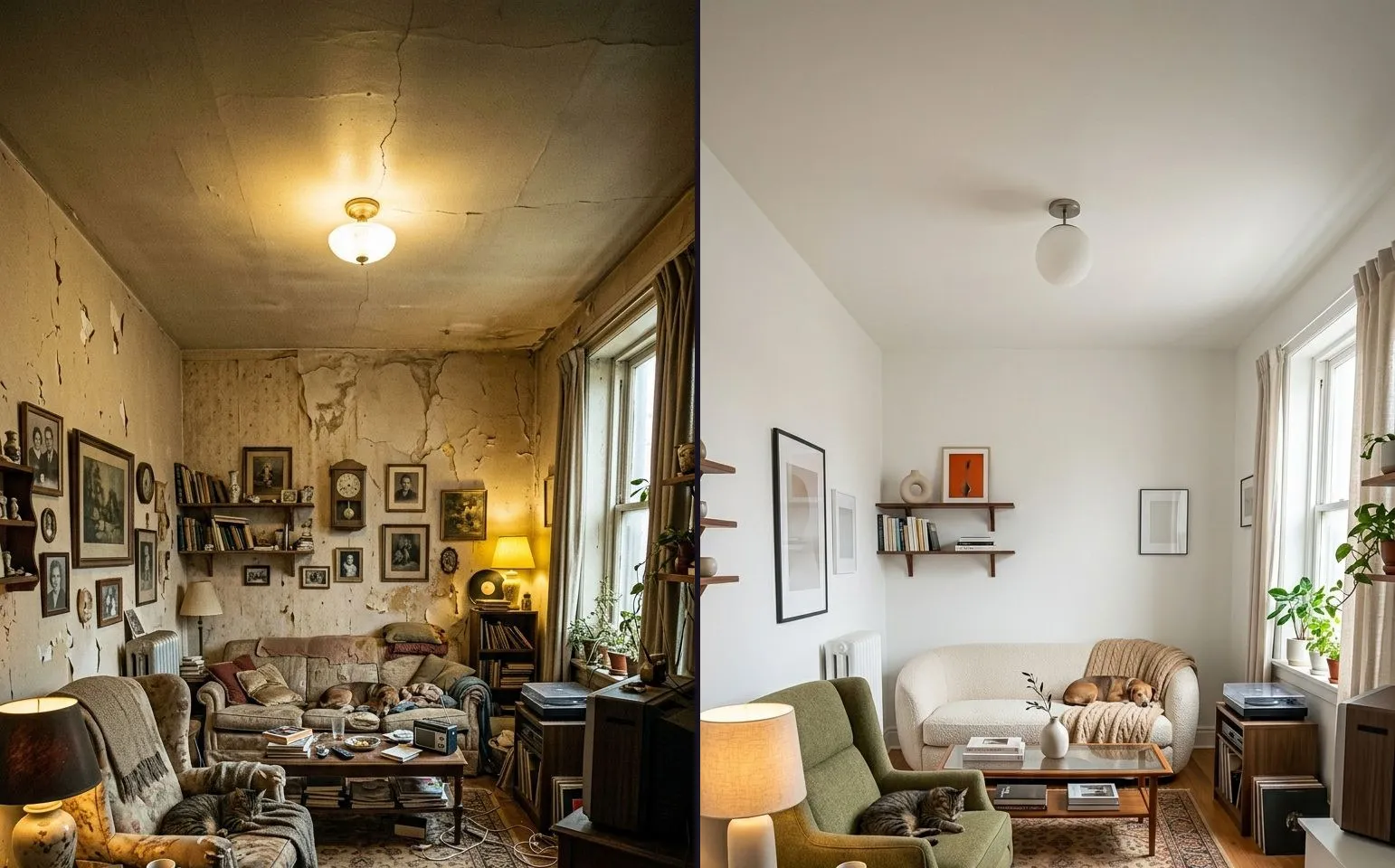
The plasterer finished on Thursday, the room looks nothing like it did, and the before photo is six weeks old. You open it, walk into the room, and realise you have no idea where you were standing when you took it.
This is the hard version of the problem. Two frames in one session is a matter of not moving. Two frames six weeks apart is a matter of reconstructing a decision you made without thinking, after the memory of making it is gone. Everything in how to take matching before and after photos still applies. What changes is that you cannot rely on remembering any of it.
Record it at the time, not later
The first shot is where the second one is won or lost. Before you put the phone away, write down five things:
- Spot. Where you stood, described against something that will not move. “Back against the door architrave, left foot on the second board.”
- Height. Chest height, eye level, waist. Say which.
- Distance. Paces or metres from the subject.
- Lens. 1x, always. Note it anyway so you do not second-guess yourself later.
- Light. Which source, and the time of day. “Window only, room lights off, about 3pm.”
Add one more line that does not matter in a same-session pair but matters enormously here: the date.
Keep the note with the photograph
A note that lives somewhere else from the photo is a note you will not find. The failure is never the writing down, it is the retrieval six weeks later on a different job.
The reliable habit is to put both in one place. Type the five lines into your phone’s notes and paste the photo into the same note. Or drop the photo and a text file into a folder named after the job. Or save the pair as a project in whatever tool you use to build the post, so the before and its details open together. Our app keeps saved projects with thumbnails and reopens them for re-editing, which means the before you shot in June is still sitting there in August with its pair half-built.
The first photograph is your best measuring tool
Here is the thing most people miss: you do not have to reconstruct the shot from your notes. You have the shot. It is a photograph, and it contains every fixed object you need.
Open the before on your phone and look for things that cannot have moved. A doorframe. The line where the skirting meets the floor. A power point. A window mullion. A kerb, a downpipe, a fence post. Then stand where you think you stood, hold the phone up, and compare. If the doorframe sits further left in your viewfinder than it does in the photo, you have moved right. If you can see more ceiling, you are holding the phone lower or you have stepped back.
Flicking between the photo and the live viewfinder works, and it is free. It is also fiddly, because you are comparing two things you cannot see at once.
This is exactly the case Ghost Camera was built for. It puts the before photograph over the live viewfinder at an opacity you choose between 0 and 70 percent, so the old doorframe and the real doorframe are in the same picture at the same time. You move until they sit on top of each other, then you shoot. Around 40 percent is usually the sweet spot: enough to see the ghost, not so much that you cannot see the room. It is free in the app, with no limit on how often you use it, and you can read what else the app does on the app page .
Anchors beat memory
If you know at the time that you will be coming back, leave yourself something physical.
Indoors, a small piece of tape on the floor survives most jobs, and where it will not, use furniture that is not going anywhere: stand with your heels against the hearth, or line your shoulder up with the edge of the kitchen island. Outdoors, use the permanent things. The third fence post. The crack in the kerb. The corner of the manhole cover. Take one wide “context” photo of yourself standing on the spot if the job is worth it, because a photo of where you stood is easier to interpret in six weeks than a sentence about it.
Time of day beats weather
People fret about waiting for a matching sky and then shoot at completely the wrong hour. It is the wrong worry.
Cloud changes how soft the light is. The clock changes where every shadow in the frame falls, which side of the building is lit, and what colour the light is. A cloudy midday and a sunny midday look far more like each other than two sunny shots taken five hours apart, because in the second case the sun has physically moved across the sky and taken the whole shadow structure of your photograph with it.
So if the before was mid-afternoon, come back mid-afternoon. If it was a grey morning, a grey morning is a bonus, not the requirement.
When you cannot get back to the exact spot
Sometimes the spot is gone. There is a new island bench where you stood. A van is parked on your mark. The scaffolding has come down and the ground level is different.
Prioritise in this order. Get the distance right first, then the camera height, then the position. Distance and height carry most of the resemblance between two frames, because they control how big the subject sits in the frame and what perspective you see it from. A shot taken from a step to the left of the original still reads as the same view. A shot taken from two steps closer, or from waist height instead of chest height, does not, and no amount of cropping will rescue it.
Match the two that matter, accept the drift on the third, and move on.
When to accept the mismatch and say so
Some pairs will not match, and the right move is a caption, not a cover-up.
“Different day, different light” costs you nothing. “Shot from a step to the left, the old spot is now a kitchen bench” is charming and it tells people you were paying attention. Readers forgive a stated mismatch completely. What they do not forgive is spotting one you were hoping they would not, because at that point they start wondering what else about the pair was arranged. That is the trust problem laid out in why your before and afters look fake , and the honest caption is the cheapest possible insurance against it.
The long-run case: a series every four weeks
The version where all of this compounds is the recurring shot. A garden photographed monthly through a season. A restoration project shot at every stage. A client series a salon shoots at each appointment.
Consistency is worth far more here than it is in a single pair, because the errors do not average out, they accumulate. Ten frames shot from ten slightly different spots produce a sequence that lurches. Ten frames shot from the same spot produce something people watch to the end.
Three habits carry it. Always ghost against the first frame in the series rather than the most recent one, or the drift compounds a little every time. Always shoot at the same hour. And keep the five-line card with the series rather than in your head, because at frame nine you will have forgotten frame one entirely.
When you are ready to turn any two of those frames into a post, the app takes two still photographs and gives back a video, a GIF or a single image, with 100 templates in the catalogue covering garden, renovation, detailing, salon and the rest. If you just want to check that two frames actually line up, do it in your browser first with the free before and after slider . Drag the handle. A pair shot properly six weeks apart will sit still while it moves, and that stillness is the whole point.
Common questions
- How do I take the same photo angle weeks later?
- Use the first photograph itself as the reference. Open it on the phone, match the fixed objects in it (a doorframe, a skirting line, a kerb) to what you see through the viewfinder, and get the distance and height right before you worry about the exact position.
- What should I write down when I take a before photo?
- Five things: where you stood, how high you held the phone, how far you were from the subject, which lens you used and which light was on. Add the time of day. Keep them in the same place as the photo so the two never get separated.
- Does the weather need to match between two outdoor shots?
- Less than you think. Time of day matters more, because the sun moves and every shadow moves with it. An overcast noon and a sunny noon match each other far better than two sunny shots taken five hours apart.
- What if I cannot stand in exactly the same place for the second photo?
- Get the distance and the camera height right first, then the position. Those two carry most of the resemblance. A small sideways shift is forgivable, a different distance or a different height is not.
- Is it better to post a mismatched pair or no pair at all?
- Post it and say so in the caption. Different day, different light, shot from a step to the left. Readers forgive a stated mismatch completely and never forgive one they catch you hiding.