How to Shoot a Carpet and Upholstery Cleaning Before and After (the Half Clean Strip)
Carpet and upholstery cleaning has the richest transformation vocabulary of any trade on this site, but the pair falls apart if the pile direction or the flash gets there first. Here is the shot that holds up.
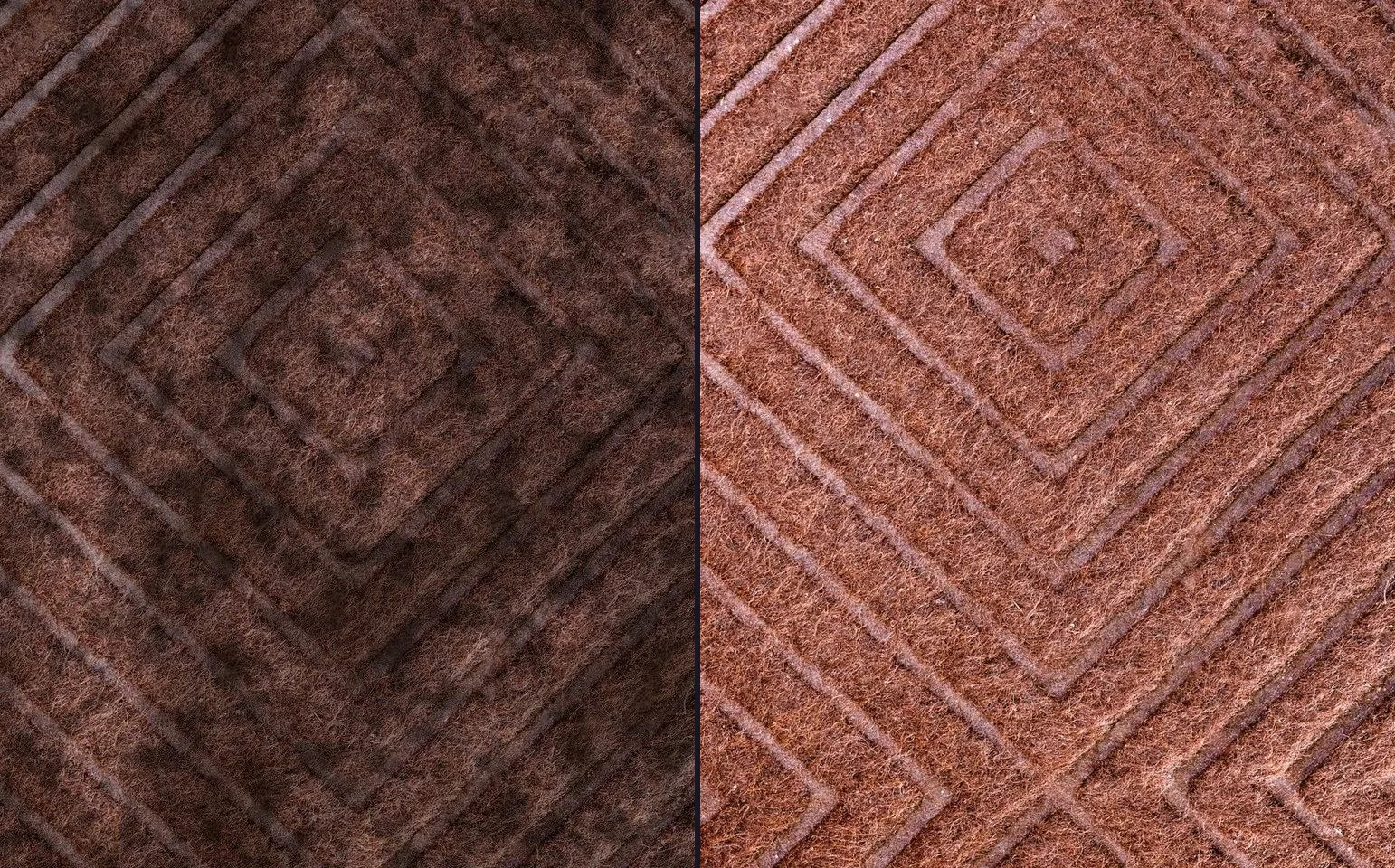
A stained carpet going back to its original pattern is one of the most satisfying things a camera can show, which is exactly why this trade gets watched by people who will never book a cleaner in their life. The rug cleaning genre on TikTok has an audience far bigger than the industry behind it, and that audience is primed to stop scrolling the moment they see pile, not paint or glass, change in front of them. The problem is that carpet and upholstery are also two of the easiest surfaces on this site to photograph wrong, because the thing that makes them satisfying, the texture, is the same thing that makes them unforgiving.
Two things ruin more carpet pairs than bad cleaning ever does: the pile points a different way in the two photographs, and a phone flash goes off in one of them. Fix those two and the method is otherwise the simplest on the site.
The half clean strip makes the pair for you
Run the wand, the brush or the cleaning pass straight down the middle of a traffic lane, a hallway, a stair tread or a stretch of lounge carpet, and stop halfway. Do not finish the pass. Step back, hold the phone steady above the lane, and take one photograph of the whole strip: dulled and stained on one side, clean on the other, the join running straight down the centre of the frame.
That single photograph is already a matched pair. Both halves were shot in the same instant, from the same height, under the same light, at the same angle, so none of the mismatches that usually wreck a before and after can happen here. There was only ever one shutter press.
Open the photo afterwards in your phone’s own editor and crop it into a left half and a right half. The stained side becomes your before. The cleaned side becomes your after. Save them separately and you have two ordinary still photographs, ready to feed into the app as a normal pair, exactly the way you would two shots taken minutes apart. The app’s picker takes two photographs in and gives you back a video, a GIF or a still image. It does not take video clips, and a half clean strip, cropped from one frame, is precisely the kind of pair it is built for.
Do this on every job that has a traffic lane or a long run of carpet, which is most of them. It costs nothing you were not already doing, since the pass through the middle of the room was happening anyway. You are only pausing for one photograph partway through it.
Why the eye needs the join
A before and an after shot as two completely separate photographs, even a well matched pair, asks the viewer to hold one frame in memory while they look at the second one. On a textured surface like carpet or upholstery fabric, that memory step is where the pair loses people, because texture does not compress well into a mental snapshot the way a clean geometric line does.
A half clean strip removes the memory step entirely. Both states sit in the same frame, at the same time, so the viewer compares them directly rather than recalling one and checking it against the other. That is also why this shot reads as more honest than two separate photographs, even when both are genuine: there is no gap in which anything could have changed except the thing you actually did.
Pile direction is the tell this trade trips over
This is the carpet-specific version of the lighting mismatches covered in why your before and afters look fake, and it catches more carpet cleaners than any lighting problem does.
Carpet pile is a field of fibres standing at a slight angle, not flat against the backing. Light bounces off the side of each fibre, so a lane brushed, walked or cleaned in one direction reflects differently to the same lane brushed or walked the other way, independently of how clean it actually is. Vacuum a lane toward the window for the before, then walk away from the window for the after, and the pile change alone can shift the apparent colour and sheen of the carpet, even in two photographs that captured a lane equally clean.
The fix is to leave the pile alone between frames, or restore it to the same direction before you shoot the after. If your cleaning process naturally brushes the pile one way, finish every pass the same direction and frame your after photograph with that direction unchanged from the before. A half clean strip sidesteps this almost entirely, because the pile across the whole strip was disturbed by the same single pass, in the same direction, at the same time, so there is nothing left to drift between the two halves.
Flash flattens texture, one consistent light does not
A direct, on camera flash fires from a few centimetres above the lens, which lights every fibre and every weave straight on and erases the shadows that give pile and fabric their depth. A carpet or a sofa cushion lit by flash reads as a flat, slightly glossy sheet in the photograph, whatever its actual condition, because the texture that would otherwise prove the before or the after has been lit out of existence.
This matters more here than almost anywhere else on this site, because texture is the entire story in a carpet or upholstery pair. A stain is partly colour and partly the way dirt sits down in the pile, holding the fibres apart and catching light differently than clean pile does. Flatten that with a flash and a stain and a clean patch can end up looking closer to identical than they are.
One steady room light, left in the same position and switched on for both frames, or a window at roughly the same time of day, keeps the fibres reading as fibres in both photographs. If the room is genuinely too dark without a flash, a phone’s own LED torch, held off to one side rather than fired as a camera flash, throws a raking light across the pile that shows the texture rather than erasing it. Use the same light, in the same position, for the before and the after, and the texture carries the proof the way it is supposed to.
The wide before you cannot go back for
The half clean strip proves the stain is gone on one lane. It is not a substitute for a wide shot of the whole room if the job you are posting or quoting against is the room, not the lane.
Take that wide before from a fixed spot, almost always the doorway, before the first pass of equipment touches the carpet. Carpet and upholstery are two of the least reversible surfaces on this site: once a fibre is wet, it sits differently, catches light differently and often looks a shade darker than it did dry, so a wide before shot after the job has started is already a compromised before. Stand in the doorway, hold the phone at the same height you will return to for the after, and get the whole lane or the whole room width in frame before anything else happens.
Which comparison mode fits which shot
Slider suits the half clean strip directly, because the join you already shot runs down the middle of the frame and a slider reveal is the same motion, left to right, as the wand pass that made it. It is also the one reveal that plays correctly in a video on the app today.
A wide room shot from the doorway is a different shape, usually wider than it is tall once the full lane is in frame, and Top and Bottom keeps that whole width visible in both the before and the after rather than squeezing it into a narrow vertical strip. For now, that is the right call for the still image export specifically, since the video exporter currently derives its layout from the reveal animation rather than the comparison mode.
Turning the pair into a post
Once you have a pair, half strip or wide room shot, the flow in the app is the same one every trade on this site uses. Pick the two photographs, choose a comparison mode, choose how the reveal plays if you are exporting a video, set the length, and export at the ratio wherever it is going: 9:16 for a Reel or a Story, 1:1 for a grid post.
It is worth saying plainly what the free tier actually gives rather than finding out at the export screen. Free is three exports a day, each behind a short ad, with a watermark on, 9:16 and 1:1 only, Slider Reveal as the only video reveal, and no music. What is free and completely ungated is everything the method above actually needs: every comparison mode including Top and Bottom, every filter, the full sticker set, the label editor, your business name and logo on the frame, and saved projects. That second list is the one to lead with, because nothing in this guide depends on paying for anything.
Dark Clean, one of the free templates, keeps the frame plain enough that a textured pair carries itself without competing decoration. Bold Purple is the better choice if you want a stain reveal to stop a scroll on a feed rather than sit quietly in a profile grid. Both sit in their own categories, clean and bold, if you want to see the rest of either pack.
Where to check the pair before you post it
Before committing to a video, run the pair through the free before and after slider on this site. It works entirely in your browser, nothing leaves your device, and it is the fastest way to see whether a carpet or upholstery pair actually holds together. A half clean strip, cropped from one photograph, sits rock steady as the handle moves, because there was nothing to misalign in the first place. If a pair shot as two separate photographs jumps, shifts, or shows the colour sliding as the handle crosses the join, the pile direction or the light is the likely cause, and no template will fix it afterwards.
This same half strip trick carries two other trades on this site that photograph a continuous surface: pressure washing uses it on concrete and render, and window cleaning uses the same stop-halfway idea on a single pane. If you work across more than one of these surfaces, the shot is worth learning once.
Post the strip, keep the wide shot for the quote
The half clean strip is the fastest, most reliable content this trade produces, and it costs nothing beyond a photograph you would not otherwise have taken mid-pass. Use it on every job with a lane worth running the wand down. Keep the wide doorway shot for the jobs where the whole room is the sell, a lounge, a landing, a full stair run, and for the quote itself rather than just the feed.
Between the two, a single visit gives you content that proves itself without staging anything, which is the whole reason this trade’s transformation format outperforms almost every other kind of cleaning content online. For the caption and hashtag rotation this trade actually uses, the carpet and upholstery cleaning hashtag page has the current pool for Instagram and TikTok, and the carpet cleaning companies data has the federal counts behind the trade if you want the numbers rather than the vibe. If you have not shot a pair on the app yet, the app is the free download the method above assumes.
Common questions
- What is the half clean strip shot for carpet cleaning?
- Run the wand down the middle of a traffic lane and stop halfway, then photograph the whole lane in one frame: dulled and stained on one side, restored on the other, the join running straight down the centre. Because it is a single photograph, the light, the angle and the distance are already identical on both sides, and you crop it into a before and an after afterwards rather than trying to match two separate shots.
- Why does my clean carpet look different in colour, not just cleaner?
- Almost always because the pile direction changed. Carpet pile is a field of tiny fibres standing at an angle, and the angle they lean at scatters light differently depending on which way you walk, vacuum or clean across them. Brushing or walking a lane in one direction and photographing it, then cleaning it and walking away in the other direction, shifts the colour and the sheen independently of how clean the fibres actually are. It is a lighting effect, not a cleaning result, and it is the tell this trade trips over most.
- Should I use flash for a carpet or upholstery before and after?
- No, not a direct on camera flash. A flash fires from right next to the lens, which flattens the pile and the fabric weave into a single flat sheet and hides the texture a before and after carpet shot depends on to read as real. One consistent, broader light source, a room light left on for both frames or a window at the same time of day, keeps the texture visible and keeps the two frames lit the same way.
- Is a half clean strip enough, or do I still need a wide before?
- The half clean strip proves the stain is gone on one lane. It does not replace a wide shot of the whole room if that is the job you are selling. Take a wide before from a fixed spot, usually the doorway, before the first pass of the wand touches anything, because once a carpet is wet the fibres sit differently and you cannot go back for a dry before.
- Which comparison mode suits a carpet or upholstery pair?
- Slider for a single lane or a cushion, since the join in a half clean strip already runs down the middle of the frame and a slider reveal echoes the same motion as the wand pass. Top and Bottom suits a whole room shot from the doorway, which is wider than it is tall once the full lane is in frame. Both are safe choices for the still image export, which honours all four comparison modes today.